Long ago, in the midst of rampant crime and economic depression, July of 1930 heard the eerie voice of The Shadow brought to life in radio broadcasts as the announcer of Street and Smith's Detective Story Hour. That was only the beginning, though. Once The Shadow started chilling spines, he moved from merely announcing stories to starring in his own adventures. Inspired by his example, scores of other heroes followed on his heels to be presented to a public hungry for uplifting tales of heroic salvation. Most of those following in the dark vigilante's wake were pale copies, lacking the appeal that would give a few the staying power that would maintain their popularity for decades to come. 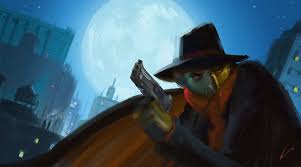 But why? Why did some persist and others fail? Why was anyone writing stories of heroic fiction at all? I mean, besides "for the money."
The time of ancient myths and legends was long since gone. Humans had grown beyond the point where they tried to explain the wonders of the universe through the supernatural workings of divine beings. For good or ill, the people of the world were fending for themselves, firmly entrenched in a grim reality of their own making. Under the crushing weight of the Great Depression, crime, unemployment and fascism were all flourishing. People felt unsafe in their homes or lost their homes entirely, some moving to other countries entirely to escape the impending threat of global war they felt powerless to stop.
The need had arisen not only to escape the dark truths of life but to foster hope for better times. A void had been carved in the hearts of the common men by increasing feelings of ineffectualness in their own world and they were desperate for a way to fill it. These needs called forth the creation of the pulp heroes with an impetus never before seen in the modern world. Pulp heroes would grow into super-heroes, like the legends of ancient myth, all working beyond the hindrance of confining laws to banish the fears of ordinary men. Nietzsche warned us to "Battle not with monsters, lest ye become a monster," but we crafted our heroes specifically to become the composite avengers of society's collective soul. Heroes overcame whatever fears were embodied by their opposition, fighting ceaselessly for truth, justice and freedom that readers felt themselves denied in their daily lives. Defying Nietzsche, here were champions serving as inspirations to all--no matter how poor, downtrodden or oppressed--as they dared gaze into the abyss of all the world's dark places.
Whether they fought darkness while draped in the color of night in the manner of The Shadow and Batman or sought to dispel it with the guiding light of hope for the future like Doc Savage and Superman,
But why? Why did some persist and others fail? Why was anyone writing stories of heroic fiction at all? I mean, besides "for the money."
The time of ancient myths and legends was long since gone. Humans had grown beyond the point where they tried to explain the wonders of the universe through the supernatural workings of divine beings. For good or ill, the people of the world were fending for themselves, firmly entrenched in a grim reality of their own making. Under the crushing weight of the Great Depression, crime, unemployment and fascism were all flourishing. People felt unsafe in their homes or lost their homes entirely, some moving to other countries entirely to escape the impending threat of global war they felt powerless to stop.
The need had arisen not only to escape the dark truths of life but to foster hope for better times. A void had been carved in the hearts of the common men by increasing feelings of ineffectualness in their own world and they were desperate for a way to fill it. These needs called forth the creation of the pulp heroes with an impetus never before seen in the modern world. Pulp heroes would grow into super-heroes, like the legends of ancient myth, all working beyond the hindrance of confining laws to banish the fears of ordinary men. Nietzsche warned us to "Battle not with monsters, lest ye become a monster," but we crafted our heroes specifically to become the composite avengers of society's collective soul. Heroes overcame whatever fears were embodied by their opposition, fighting ceaselessly for truth, justice and freedom that readers felt themselves denied in their daily lives. Defying Nietzsche, here were champions serving as inspirations to all--no matter how poor, downtrodden or oppressed--as they dared gaze into the abyss of all the world's dark places.
Whether they fought darkness while draped in the color of night in the manner of The Shadow and Batman or sought to dispel it with the guiding light of hope for the future like Doc Savage and Superman, 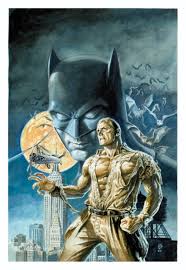 we have never truly lost our need for iconic heroes. In recent years, with increasing amounts of cynicism afoot, we've seen the rise of anti-heroes and the darkening of heroic figures, perhaps finally succumbing to the weight of fighting so much evil for so long. They say that tarnishing these icons humanizes them, making them seem more real and relatable to audiences. In its own way, this trend toward favoring a flawed hero may be part of a collective self-awareness as to just how close to home the hero's true foe dwells.
 A common lament in heroic fiction is the hero's claim that he works to create a world in which he will no longer be needed. No matter how far we travel, how much we strive or learn, until we overcome our own darkness--the fears that lurk in the hearts of man--we'll never run short of evils to fight or the need for champions to face them. In truth, even though our heroes seem to be caught in nothing less than neverending battles, what they truly represent is our collective desire to better ourselves and our world. Should we as a people reach a point where we cynically banish our heroes it would mean that we have chosen to do away with our role models, ceased projecting the better and more hopeful parts of our natures and, sadly, stopped imagining a brighter world in which to live.
I side with the good guys. I'll let you know that up front. I enjoy heroes, even the ones with the tarnish on their armor. I'll go as far as enjoying an anti-hero when there's no better option. I suppose it has more to do with being able to see a respectable mission statement driving their actions. I love Superman and Wonder Woman, but I also am a fierce supporter of Batman and The Shadow and Jack Bauer.
I don't cheer for the bad guys or think they're cool. Sure, I can see that there are varying shades of bad, ranging from the laughable and sad all the way out to horrifying agents of inhuman evil. Some people find themselves drawn to the seductions of the dark and consider those of a heroic nature to be weak or "lame". I keep an eye on those people. They make me wonder about them.
I don't live under a rock, so I've seen the rise in interest of vampires as heroic and romantic figures rather than as predatory villains that an audience will enjoy seeing defeated. I still find this a curious phenomenon and find that fighting the dark side makes far more sense. Give me "Blade" over "Twilight" any day. I'm still on the fence over "Star Wars", since Lucas added all that stuff about the "good guys" starting up a slave army. I definitely wasn't crazy about Darth Maul being a popular Halloween costume choice.
Long ago, I went to watch a movie with a friend. It was a comedy remake of a foreign film that ran longer than it needed to, but my friend really wanted to see it. Let's just say that it focused on three men and a baby of uncertain parentage. This was an era when irresponsible sex or, as Julia Roberts taught us, being a prostitute to a rich guy was funny. Anyway, at the climax of the film, a couple of the men and the baby were being pursued by gun-wielding criminals intent on doing bodily harm to the helpless comic actors. My friend bounced on the edge of her seat tensely urging the protagonists to "Get away! Get away!" with anxious whispers. To me, it was obvious that they'd come out OK because this wasn't the kind of movie that Hollywood was about to throw a bloody body count into any sooner than they would bring a serial killing pedophile onto "Full House" to destroy the Olsen twin empire in its infancy. Still, she made me wonder..."Are there bad guys out there cheering for the criminals to catch the men and the baby even though it was clear that there was no chance of evil triumphing in this movie?" There was no way for me to answer that at the time, so I filed it away in the vast brain cell storage repository I keep atop my neck.
A few years later, I was on a business trip. I worked for IBM at the time, so they were fairly common. On this particular trip, I had the good fortune to meet a lot of people from different parts of the country and talk with one who had worked on a computer network installation in a juvenile detention center. Well, having not had the exposure to the criminal element that I would in years to come, I leapt on the opportunity to explain to him my movie theater question and ask if he had perhaps gleaned any insight he could offer me. He paused thoughtfully and cocked his head to one side as he searched his own memory repository, then looked at me with epiphanous intensity as he said, "You know, they do!"
Ah, sweet confirmation! Even though our entertainment industry has given us the hard-sell on messages like "crime doesn't pay" and "good will triumph", bad guys will cheer for bad guys. Who doesn't like Superman? Bad guys, that's who. When you're composing your next work of intriguing fiction and remembering to infuse your antagonist with heaping quantities of humanity for the audience to identify with, don't be shy about making bad guys bad. Why? Because they are. I've met a lot of them. They're human, but they're quite willing to disregard that you are. Some of them are good at hiding their dark qualities from the masses, but they do harbor them and eagerly seek the bright virtues in you that afford them ready prey. They seek your trust and your empathy. Whether harboring fear or anger or whatever other dark motivators, bad guys are ultimately true to their labels. They range from the laughable and pitiable to the cold and monstrous.
Flirting with the dark may give you a thrill, but you're turning your back on what's good for you to invite something bad inside. Next time you're relishing your gaze into the abyss, delightfully engaged by intriguing villainy, be careful not to lose yourself in there. You have to live with what comes back out.

