Equilibrium (Balance) is a natural state in our universe.
It exists between Bright and Dark, Order and Chaos. What we call "good" and "evil" are extreme symptoms on the spectrum of being unbalanced. Being completely self-serving can be as spiritually unhealthy as being completely self-sacrificing can be physically unhealthy. See how that complementary thing works? Good. Now, what does it mean for your antagonists and protagonists?
Superman and certain other superheroes can get away more altruism than most because of their powers. For most mere mortals, though, not taking care of yourself comes with great consequences. A hero can only donate so much blood and flesh, block so many bullets and knife blades, and chase societies enemies for only a finite amount of time without some rest and a bite to eat. No, all the food can't go to the starving children. You have to take care of yourself to a certain degree to be able to continue making sacrifices for others.
Sliding to the other end of the spectrum, kicking puppies and eating orphans will damage the spirit and erode the villainous from within. Vampires lose their reflections and we could go through a litany of specific vile figures whose dark indulgences have guided their withered souls far from the light, but I'd be naming politicians and supervillains all day. Their cost is more than just white hair and disfigurement, it's the essence of their humanity itself. Each destructive choice takes its toll on the villain as well as the victim. At the extreme, what remains will be either a figure of unfeeling cruelty or utter madness with neither maintaining more than a parasitic or predatory connection to mankind. And we're back to Congress again.
Let me get to that divergence another time. The point is that when you develop your characters, there's a lot of middle ground available between Paragon of Virtue and Embodiment of Malevolence. I'm sure you've heard it before, but many of the most interesting characters are going to be found occupying those middle grounds. In the course of going through a story, they may even change positions on the spectrum. It doesn't have to be a change from one end to the other. The Grinch managed to pull that one off, but not everyone can do it as convincingly. What's important is that the audience gets to learn more about them by the end than was known at the beginning.
If you're feeling generous, you might even let your character in on it.
Showing posts with label evil. Show all posts
Showing posts with label evil. Show all posts
Saturday, January 4, 2014


Saturday, December 28, 2013
17246--In Dark Places
At least some of us pay attention to the world around us.
When we do, many of us wonder what goes on in the minds of those who shun the light, those who wear the mask of humankind yet commit deeds deemed dark, violent, and just plain evil against others. What makes those we call villains villainous?
Is it as simple as attachment? Is it clinging to desire for things denied? Not all who want go so far as to impose their will on others, though. What pushes one person to violate the rights of another? We've all heard it before. The common experiences that drive these actions are fear, anger, hatred and suffering. Fear itself is anticipatory of an experience. Anger and hatred are indicators of the level of attachment placed on experiences. Suffering is what remains, the scars of a traumatizing experience typically measured in terms of perceived intensity and endurance. At its worst, suffering survived manifests as madness, scarring so severe on one's intangible essence of self that the resultant alterations can become utterly abhorrent. Those whose selves have become so lost as to become a menace to themselves and those around them, may have no chance of recovery.
"Whom the gods would destroy, they first make mad," said Prometheus (Longfellow, The Masque of Pandora).
To be cut from the cloth of Moriarty, Keyser Soze, Ozymandias, Morgan Le Fay, Shiwan Khan, Sauron or Emperor Palpatine, is to have found the path to wrangling the wills of others. It was easily done because the will of others is insignificant next to people whose self-perceived greatness has set them beyond the laws and conventions of ordinary mortals. Megalomania is a special form of madness where an easily understandable lust for greater power is coupled with genius enough to make it seem attainable. From there, who knows how far one may try to run with it?
Penguin, on the other hand, does have distinctive personality traits. His upbringing was that of a studious "mama's boy". She's the one who pushed him to always carry the umbrella. He's very intelligent, but also obsessive. He has been portrayed as greedy, cunning, vengeful, social-climbing, approval-seeking. His drives come from greed, obsession and insecurity. Unlike many of Batman's foes, he's not emotionally disturbed or blatantly insane. He is, however, determined not to be the impoverished, persecuted misfit he was as a child.
Lex Luthor's desire for greatness is certainly megalomania, but his usual entertainment of blissfully crushing the dreams of others (not to mention the occasional bare-handed strangulation) and toying with their tiny lives became overshadowed by his burning hatred for Superman. Worse than having his spotlight stolen, suffering the humiliation of interference in his plans is more than Luthor is willing to endure. His greatest goal is to see Superman dead, with impunity, by his hand. Luthor is so dedicated to this end that he has even helped Superman against other villains to save Superman for himself.
Maybe that sounds crazy, but he's not the only one who'd go so far. Stop me if you've heard this one...
Joker's stand-out feature isn't that he's a cunning mastermind or even the snappiest dresser (not to say he has anything short of killer fashion sense), but a mind driven to chaos. Born from suffering and loss, his unbridled unpredictability is one of his greatest assets. He wants to dance and Batman is the only dance partner he truly cares about. The steps he takes to lead the way into madness are those he thinks are funny. He doesn't just kill anyone available or steal shiny things. He doesn't just spray acid and create mayhem for mayhem's sake. He does it all for laughs. How dark is the heart that sees every bruise, broken bone or murdered victim not as perpetrated evil, but as one more punchline in a neverending series of jokes?
When we do, many of us wonder what goes on in the minds of those who shun the light, those who wear the mask of humankind yet commit deeds deemed dark, violent, and just plain evil against others. What makes those we call villains villainous?
Is it as simple as attachment? Is it clinging to desire for things denied? Not all who want go so far as to impose their will on others, though. What pushes one person to violate the rights of another? We've all heard it before. The common experiences that drive these actions are fear, anger, hatred and suffering. Fear itself is anticipatory of an experience. Anger and hatred are indicators of the level of attachment placed on experiences. Suffering is what remains, the scars of a traumatizing experience typically measured in terms of perceived intensity and endurance. At its worst, suffering survived manifests as madness, scarring so severe on one's intangible essence of self that the resultant alterations can become utterly abhorrent. Those whose selves have become so lost as to become a menace to themselves and those around them, may have no chance of recovery.
"Whom the gods would destroy, they first make mad," said Prometheus (Longfellow, The Masque of Pandora).
To be cut from the cloth of Moriarty, Keyser Soze, Ozymandias, Morgan Le Fay, Shiwan Khan, Sauron or Emperor Palpatine, is to have found the path to wrangling the wills of others. It was easily done because the will of others is insignificant next to people whose self-perceived greatness has set them beyond the laws and conventions of ordinary mortals. Megalomania is a special form of madness where an easily understandable lust for greater power is coupled with genius enough to make it seem attainable. From there, who knows how far one may try to run with it?
Penguin, on the other hand, does have distinctive personality traits. His upbringing was that of a studious "mama's boy". She's the one who pushed him to always carry the umbrella. He's very intelligent, but also obsessive. He has been portrayed as greedy, cunning, vengeful, social-climbing, approval-seeking. His drives come from greed, obsession and insecurity. Unlike many of Batman's foes, he's not emotionally disturbed or blatantly insane. He is, however, determined not to be the impoverished, persecuted misfit he was as a child.
Lex Luthor's desire for greatness is certainly megalomania, but his usual entertainment of blissfully crushing the dreams of others (not to mention the occasional bare-handed strangulation) and toying with their tiny lives became overshadowed by his burning hatred for Superman. Worse than having his spotlight stolen, suffering the humiliation of interference in his plans is more than Luthor is willing to endure. His greatest goal is to see Superman dead, with impunity, by his hand. Luthor is so dedicated to this end that he has even helped Superman against other villains to save Superman for himself.
Maybe that sounds crazy, but he's not the only one who'd go so far. Stop me if you've heard this one...
Joker's stand-out feature isn't that he's a cunning mastermind or even the snappiest dresser (not to say he has anything short of killer fashion sense), but a mind driven to chaos. Born from suffering and loss, his unbridled unpredictability is one of his greatest assets. He wants to dance and Batman is the only dance partner he truly cares about. The steps he takes to lead the way into madness are those he thinks are funny. He doesn't just kill anyone available or steal shiny things. He doesn't just spray acid and create mayhem for mayhem's sake. He does it all for laughs. How dark is the heart that sees every bruise, broken bone or murdered victim not as perpetrated evil, but as one more punchline in a neverending series of jokes?
Friday, June 22, 2012
16689--From the Heart of Darkness Comes the Neverending Battle
Long ago, in the midst of rampant crime and economic depression, July of 1930 heard the eerie voice of The Shadow brought to life in radio broadcasts as the announcer of Street and Smith's Detective Story Hour. That was only the beginning, though. Once The Shadow started chilling spines, he moved from merely announcing stories to starring in his own adventures. Inspired by his example, scores of other heroes followed on his heels to be presented to a public hungry for uplifting tales of heroic salvation. Most of those following in the dark vigilante's wake were pale copies, lacking the appeal that would give a few the staying power that would maintain their popularity for decades to come. 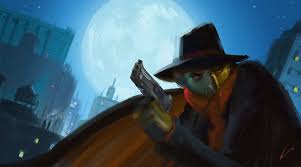
But why? Why did some persist and others fail? Why was anyone writing stories of heroic fiction at all? I mean, besides "for the money."
The time of ancient myths and legends was long since gone. Humans had grown beyond the point where they tried to explain the wonders of the universe through the supernatural workings of divine beings. For good or ill, the people of the world were fending for themselves, firmly entrenched in a grim reality of their own making. Under the crushing weight of the Great Depression, crime, unemployment and fascism were all flourishing. People felt unsafe in their homes or lost their homes entirely, some moving to other countries entirely to escape the impending threat of global war they felt powerless to stop.
The need had arisen not only to escape the dark truths of life but to foster hope for better times. A void had been carved in the hearts of the common men by increasing feelings of ineffectualness in their own world and they were desperate for a way to fill it. These needs called forth the creation of the pulp heroes with an impetus never before seen in the modern world. Pulp heroes would grow into super-heroes, like the legends of ancient myth, all working beyond the hindrance of confining laws to banish the fears of ordinary men. Nietzsche warned us to "Battle not with monsters, lest ye become a monster," but we crafted our heroes specifically to become the composite avengers of society's collective soul. Heroes overcame whatever fears were embodied by their opposition, fighting ceaselessly for truth, justice and freedom that readers felt themselves denied in their daily lives. Defying Nietzsche, here were champions serving as inspirations to all--no matter how poor, downtrodden or oppressed--as they dared gaze into the abyss of all the world's dark places.
Whether they fought darkness while draped in the color of night in the manner of The Shadow and Batman or sought to dispel it with the guiding light of hope for the future like Doc Savage and Superman,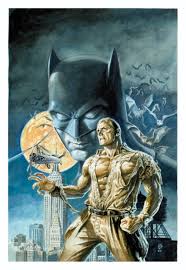 we have never truly lost our need for iconic heroes. In recent years, with increasing amounts of cynicism afoot, we've seen the rise of anti-heroes and the darkening of heroic figures, perhaps finally succumbing to the weight of fighting so much evil for so long. They say that tarnishing these icons humanizes them, making them seem more real and relatable to audiences. In its own way, this trend toward favoring a flawed hero may be part of a collective self-awareness as to just how close to home the hero's true foe dwells.
A common lament in heroic fiction is the hero's claim that he works to create a world in which he will no longer be needed. No matter how far we travel, how much we strive or learn, until we overcome our own darkness--the fears that lurk in the hearts of man--we'll never run short of evils to fight or the need for champions to face them. In truth, even though our heroes seem to be caught in nothing less than neverending battles, what they truly represent is our collective desire to better ourselves and our world. Should we as a people reach a point where we cynically banish our heroes it would mean that we have chosen to do away with our role models, ceased projecting the better and more hopeful parts of our natures and, sadly, stopped imagining a brighter world in which to live.
But why? Why did some persist and others fail? Why was anyone writing stories of heroic fiction at all? I mean, besides "for the money."
The time of ancient myths and legends was long since gone. Humans had grown beyond the point where they tried to explain the wonders of the universe through the supernatural workings of divine beings. For good or ill, the people of the world were fending for themselves, firmly entrenched in a grim reality of their own making. Under the crushing weight of the Great Depression, crime, unemployment and fascism were all flourishing. People felt unsafe in their homes or lost their homes entirely, some moving to other countries entirely to escape the impending threat of global war they felt powerless to stop.
The need had arisen not only to escape the dark truths of life but to foster hope for better times. A void had been carved in the hearts of the common men by increasing feelings of ineffectualness in their own world and they were desperate for a way to fill it. These needs called forth the creation of the pulp heroes with an impetus never before seen in the modern world. Pulp heroes would grow into super-heroes, like the legends of ancient myth, all working beyond the hindrance of confining laws to banish the fears of ordinary men. Nietzsche warned us to "Battle not with monsters, lest ye become a monster," but we crafted our heroes specifically to become the composite avengers of society's collective soul. Heroes overcame whatever fears were embodied by their opposition, fighting ceaselessly for truth, justice and freedom that readers felt themselves denied in their daily lives. Defying Nietzsche, here were champions serving as inspirations to all--no matter how poor, downtrodden or oppressed--as they dared gaze into the abyss of all the world's dark places.
Whether they fought darkness while draped in the color of night in the manner of The Shadow and Batman or sought to dispel it with the guiding light of hope for the future like Doc Savage and Superman,
A common lament in heroic fiction is the hero's claim that he works to create a world in which he will no longer be needed. No matter how far we travel, how much we strive or learn, until we overcome our own darkness--the fears that lurk in the hearts of man--we'll never run short of evils to fight or the need for champions to face them. In truth, even though our heroes seem to be caught in nothing less than neverending battles, what they truly represent is our collective desire to better ourselves and our world. Should we as a people reach a point where we cynically banish our heroes it would mean that we have chosen to do away with our role models, ceased projecting the better and more hopeful parts of our natures and, sadly, stopped imagining a brighter world in which to live.
Subscribe to:
Posts (Atom)